Year-wise Biology practice

NEET (Oct)2020 Biology PYQs

Check your understanding, bookmark questions and revisit your mistakes.

Page score: 0/40
Choose an answer to begin.

Practice scoring: +4 correct, 0 incorrect. Filters apply to this page. Use timed tests for negative marking.

Answers and bookmarks are saved in this browser, across visits. They do not sync to your account.

89 questions in this collection Β· Page 2 of 9

Question 11 of 89
🟒 NEET (Oct)2020 πŸ“˜ CLASS XI

Morphology Of Flowering Plants

Correct position of floral parts over thalamus in mustard plant is:
Request an AI explanation using Show explanation.
Question 12 of 89
🟒 NEET (Oct)2020 πŸ“˜ CLASS XI

Morphology Of Flowering Plants

Identify the correct features of Mango and Coconut fruits.
(I) In both fruit is a drupe
(II) Endocarp is edible in both
(III) Mesocarp in Coconut is fibrous, and in Mango it is fleshy
(IV) In both, fruit develops from monocarpellary ovary
Select the correct option from below :
Request an AI explanation using Show explanation.
Question 13 of 89
🟒 NEET (Oct)2020 πŸ“˜ CLASS XI

Morphology Of Flowering Plants

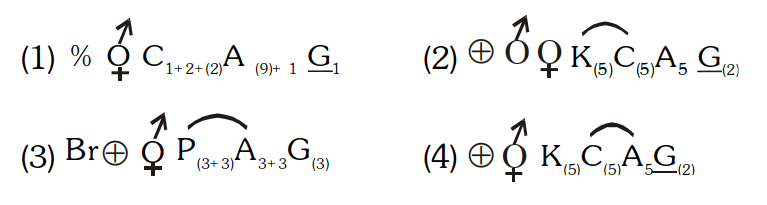
Which of the following is the correct floral formula of Liliaceae ?
Question illustration

AI-generated explanation. Check against your textbook.

Explanation:

NCERT states that Liliaceae flowers are trimerous (three petals and three sepals, often indistinguishable as tepals), with six stamens, and a single, superior ovary. The floral formula is thus K(3) C(3) A(6) G(1) with the ovary superior. The correct option among the given choices is therefore option 3, which represents this pattern. Distinguish from options showing inferior ovary (G with a parenthesis or I indicating inferior), or from those indicating zygomorphy or a different stamen count; those do not match Liliaceae’s NCERT description.

🧠 Did You Know?

In Liliaceae, the perianth segments are usually similar in appearance (tepals), making calyx and corolla indistinguishable in the floral formula.

πŸ’‘ NCERT Memory Line:

Liliaceae: K(3) C(3) A(6) G(1); superior ovary.

Question 14 of 89
🟒 NEET (Oct)2020 πŸ“˜ CLASS XI

Anatomy Of Flowering Plants

Which of the following statements about cork cambium is incorrect?
Request an AI explanation using Show explanation.
Question 15 of 89
🟒 NEET (Oct)2020 πŸ“˜ CLASS XI

Structural Organisation In Animals

In cockroach, identify the parts of the foregut in correct sequence :-
Request an AI explanation using Show explanation.
Question 16 of 89
🟒 NEET (Oct)2020 πŸ“˜ CLASS XI

Structural Organisation In Animals

Match the following columns with reference to cockroach and select the correct option:
Column-I Column-II
(A)Grinding of the food particles (I)Hepatic caecal
(B)Secrete gastric juice (II)10th segment
(C)10 pairs (III)Proventriculus
(D)Anal cerci (IV)Spiracles
(V)Alary muscles
Choose the correct answer from the options given below:
Request an AI explanation using Show explanation.
Question 17 of 89
🟒 NEET (Oct)2020 πŸ“˜ CLASS XI

Cell The Unit Of Life

Inclusion bodies of blue-green, purple and green photosynthetic bacteria are:
Request an AI explanation using Show explanation.
Question 18 of 89
🟒 NEET (Oct)2020 πŸ“˜ CLASS XI

Cell The Unit Of Life

The biosynthesis of ribosomal RNA occurs in:
Request an AI explanation using Show explanation.
Question 19 of 89
🟒 NEET (Oct)2020 πŸ“˜ CLASS XI

Cell The Unit Of Life

Match the following columns and select the correct option:
Column-I Column-II
(A)Smooth endoplasmic reticulum (I)Protein synthesis
(B)Rough endoplasmic reticulum (II)Lipid synthesis
(C)Golgi complex (III)Glycosylation
(D)Centriole (IV)Spindle formation
Request an AI explanation using Show explanation.
Question 20 of 89
🟒 NEET (Oct)2020 πŸ“˜ CLASS XI

Cell The Unit Of Life

Which of the following elements helps in maintaining the structure of ribosomes?

AI-generated explanation. Check against your textbook.

Explanation:

Magnesium (Mg2+) helps maintain the structure of ribosomes by stabilizing rRNA and ribosomal subunits, which is essential for proper protein synthesis. This is in line with NCERT, which notes the importance of Mg2+ in ribosome stability during translation. The other elementsβ€”Zinc, Copper, and Molybdenumβ€”are involved in different cellular functions (enzymes and electron transport) but are not described as maintaining ribosome structure in NCERT.

🧠 Did You Know?

Ribosomes require divalent cations like magnesium to maintain their shape and function during protein production.

πŸ’‘ NCERT Memory Line:

Magnesium stabilizes ribosomal structure for translation.
Page score: 0/40