AI-generated explanation. Check against your textbook.
Explanation:
Axile placentation means ovules attached to a central axis in a multilocular ovary. In NCERT, axile placentation is observed in China rose (Hibiscus), Petunia, and Lemon, where ovules are arranged around the central axis of the locules. Hence option 1 is correct.
🧠 Did You Know?
Axile placentation is common in many plants with syncarpous ovaries, where all carpels are fused into a single ovary with a central column.
💡 NCERT Memory Line:
Axile placentation: ovules on central axis of a multilocular ovary (common in Hibiscus and Petunia).
Family Fabaceae differs from Solanaceae and Liliaceae. With respect to the stamens, pick out the characteristics specific to family Fabaceae but not found in Solanaceae or Liliaceae.
AI-generated explanation. Check against your textbook.
Explanation:
In Fabaceae, the stamens are diadelphous: nine filaments are fused to form a common tube, leaving one filament free. The anthers are typically dithecous, i.e., each anther has two thecae. This combination (diadelphous stamens with dithecous anthers) is characteristic of Fabaceae and is not seen in Solanaceae or Liliaceae, according to NCERT descriptions of floral structure.
🧠 Did You Know?
Solanaceae and Liliaceae generally show stamens that are epipetalous (attached to petals), unlike the diadelphous condition seen in Fabaceae.
💡 NCERT Memory Line:
Fabaceae has diadelphous stamens (9 fused + 1 free) with dithecous anthers—distinct from the other families.
Which one of the following plants shows vexillary aestivation and diadelphous stamens?
AI-generated explanation. Check against your textbook.
Explanation:
The correct answer is 2) Pisum sativum. In peas, flowers are papilionaceous with vexillary (banner) aestivation, where petals arrange as standard, two wings, and a keel. The stamens are diadelphous (9 fuse to form a sheath and 1 remains free). This floral organization is characteristic of legumes as described in NCERT.
🧠 Did You Know?
Papilionaceous flowers belong to Fabaceae and exhibit a butterfly-like shape and protective diadelphous stamens, aiding pollination.
💡 NCERT Memory Line:
Legumes show papilionaceous flowers with vexillary aestivation and diadelphous stamens, as in Pisum sativum.
Identify the correct set of statements :
A.The leaflets are modified into pointed hard thorns in Citrus and Bougainvillea.
B.Axillary buds form slender and spirally coiled tendrils in cucumber and pumpkin.
C.Stem is flattened and fleshy in Opuntia and modified to perform the function of leaves.
D.Rhizophora shows vertically upward growing roots that help to get oxygen for respiration.
E.Subaerially growing stems in grasses and strawberry help in vegetative propagation.
Choose the correct answer from the options given below :
AI-generated explanation. Check against your textbook.
Explanation:
From NCERT, Opuntia has flattened, fleshy stems (cladodes) that perform photosynthesis like leaves, so C is correct. Mangroves like Rhizophora have pneumatophores (vertical roots) for oxygen, so D is correct. Strawberry and grasses have above-ground (subaerial) stems—stolons or runners—involved in vegetative propagation, so E is correct. A is incorrect because in Citrus and Bougainvillea thorns are modified branches, not leaflets. B is incorrect since tendrils in cucumber and pumpkin arise from modified shoots/axillary structures, not simply axillary buds forming spirally coiled tendrils. Therefore, the correct set is C, D and E (Option 3).
🧠 Did You Know?
In Opuntia, the original leaves are reduced to minute scales, while the flattened stems carry out photosynthesis—an adaptation for desert life.
AI-generated explanation. Check against your textbook.
Explanation:
Diadelphous stamens are two bundles of stamens usually seen in the Fabaceae family. In pea (Pisum sativum), the 10 stamens are arranged as 9 fused stamens forming a tube and 1 free stamen, i.e., they occur in two distinct groups. This arrangement is characteristic of many leguminous plants and is described in NCERT under floral morphology of dicot plants. Among the options, pea is the legume with diadelphous stamens, while China rose (Hibiscus) has many stamens united into a single column; citrus has numerous free stamens without two clear bundles. Thus, the correct choice is Pea (option 3).
🧠 Did You Know?
Diadelphous stamens form a specialized anther arrangement that aids pollen presentation in some legumes.
💡 NCERT Memory Line:
Diadelphous stamens are two bundles common in Fabaceae (peas), with 9 fused in one bundle and 1 free in the other.
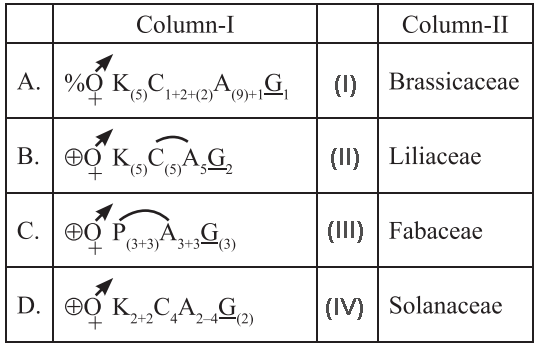
Match Column-I with Column-II.
Choose the correct answer from the options given below:
AI-generated explanation. Check against your textbook.
Explanation:
The correct choice is 4: A-III, B-IV, C-II, D-I. In NCERT-based matching questions, each item in Column-I pairs with the most appropriate description in Column-II. The sequence in option 4 aligns each A, B, C, D with the description that NCERT identifies as its corresponding feature or step, while the other options misplace one or more pairings, leading to incorrect matches. This strict one-to-one correspondence is the key principle in such questions.
🧠 Did You Know?
NCERT emphasizes clear pairings between processes or structures in biology, helping students solidify conceptual links rather than memorize isolated facts.
💡 NCERT Memory Line:
Match each item in Column-I with the most appropriate description in Column-II; only one option gives all correct pairings.
AI-generated explanation. Check against your textbook.
Explanation:
In NCERT, half-inferior (also called half-embedded) ovary means the ovary is partly below the point of attachment. Plum (Prunus) shows this condition, so the ovary is half-inferior. Thus option 4 is correct.
🧠 Did You Know?
Ovary position helps categorize flowers as superior, half-inferior, or inferior, affecting fruit development and floral structure.
💡 NCERT Memory Line:
Ovary position is a key feature in identifying different fruit types; plum is an example of half-inferior ovary as per NCERT explanations.