Identify the correct features of Mango and Coconut fruits.
(I) In both fruit is a drupe
(II) Endocarp is edible in both
(III) Mesocarp in Coconut is fibrous, and in Mango it is fleshy
(IV) In both, fruit develops from monocarpellary
ovary
Select the correct option from below :
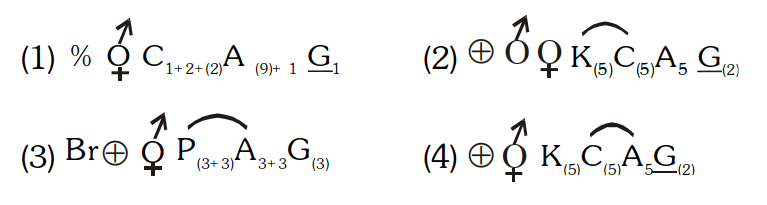
Which of the following is the correct floral formula of Liliaceae ?
AI-generated explanation. Check against your textbook.
Explanation:
NCERT states that Liliaceae flowers are trimerous (three petals and three sepals, often indistinguishable as tepals), with six stamens, and a single, superior ovary. The floral formula is thus K(3) C(3) A(6) G(1) with the ovary superior. The correct option among the given choices is therefore option 3, which represents this pattern. Distinguish from options showing inferior ovary (G with a parenthesis or I indicating inferior), or from those indicating zygomorphy or a different stamen count; those do not match Liliaceae’s NCERT description.
🧠 Did You Know?
In Liliaceae, the perianth segments are usually similar in appearance (tepals), making calyx and corolla indistinguishable in the floral formula.
The transverse section of a plant shows following
anatomical features:
(a) Large number of scattered vascular bundles
surrounded by bundle sheath.
(b) Large conspicuous parenchymatous ground
tissue.
(c) Vascular bundles conjoint and closed.
(d) Phloem parenchyma absent.
Identify the category of plant and its part:
AI-generated explanation. Check against your textbook.
Explanation:
The features describe a monocotyledonous stem. In monocots, vascular bundles are numerous and scattered throughout the ground tissue, each bundle is surrounded by a bundle sheath, and the ground tissue is largely parenchymatous. Bundles are conjoint and closed (no cambium), and phloem parenchyma is typically absent around the bundles. These characteristics match NCERT’s description of monocot stems, not roots or dicot stems.
? Did You Know?
In monocot stems, there is no distinct cortex–pith arrangement like in dicot stems, and secondary growth is generally absent.
? NCERT Memory Line:
Monocot stem: scattered vascular bundles, bundle sheath around bundles, no true vascular cambium, parenchymatous ground tissue.
Which of the following elements helps in maintaining the structure of ribosomes?
AI-generated explanation. Check against your textbook.
Explanation:
Magnesium (Mg2+) helps maintain the structure of ribosomes by stabilizing rRNA and ribosomal subunits, which is essential for proper protein synthesis. This is in line with NCERT, which notes the importance of Mg2+ in ribosome stability during translation. The other elements—Zinc, Copper, and Molybdenum—are involved in different cellular functions (enzymes and electron transport) but are not described as maintaining ribosome structure in NCERT.
🧠 Did You Know?
Ribosomes require divalent cations like magnesium to maintain their shape and function during protein production.
💡 NCERT Memory Line:
Magnesium stabilizes ribosomal structure for translation.