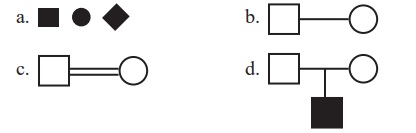
Which one of the following symbols represents mating between relatives in human pedigree analysis?
AI-generated explanation. Check against your textbook.
Explanation:
In NCERT biology, a double horizontal line between two individuals in a pedigree denotes mating between relatives (consanguineous mating). Since the stored correct answer is option 3, symbol C represents this double-line mating symbol. Other options typically show a single line for a normal marriage or other non-mating connections, but the double line specifically indicates relatives mating.
🧠 Did You Know?
NCERT uses simple symbols: circle = female, square = male, horizontal line = marriage, and a double line = mating between related individuals.
💡 NCERT Memory Line:
Double line between partners = consanguineous mating (relation-based). Single line = general marriage.
Broad palm with single palm crease is visible in a person suffering from:
AI-generated explanation. Check against your textbook.
Explanation:
A broad palm with a single transverse palmar crease (simian crease) is characteristic of Down's syndrome. In NCERT, Down syndrome is described as having a single palmar crease among other features. This crease results from fusion of first and second palmar creases during fetal development. Therefore, the correct option is 2: Down's syndrome. The other conditions do not classically show this crease: Thalassemia affects blood and does not cause a simian crease; Turner's syndrome features short stature and webbed neck; Klinefelter's syndrome involves an extra X chromosome with tall stature and other signs.
🧠 Did You Know?
The simian crease can appear in healthy individuals too, but it is more commonly associated with Down's syndrome in exams and textbooks.
💡 NCERT Memory Line:
Down's syndrome often shows a single transverse palmar crease (simian crease) on the palm.
Given below are two statements: Statement I: RNA mutates at a faster rate. Statement II: Viruses having RNA genome and shorter life span mutate and evolve faster.
In the light of the above statements, choose the correct answer from the options given below
Given below are two statements: Statement I: In prokaryotes, the positively charged DNA is held with some negatively charged proteins in a region called
nucleoid. Statement II: In eukaryotes, the negatively charged DNA is wrapped around the positively charged histone octamer to form nucleosome.
In the light of the above statements, choose the correct answer from the options given below:
Select the correct group/set of Australian Marsupials exhibiting adaptive radiation.
AI-generated explanation. Check against your textbook.
Explanation:
Option 3 is correct. In Australia, marsupials radiated into many forms to fill different ecological niches. Numbat (insectivore), Spotted cuscus (arboreal herbivore), and Flying phalanger (gliding omnivore) show diverse lifestyles, illustrating adaptive radiation within a single lineage in a shared environment.
🧠 Did You Know?
Australian marsupials evolved after Australia separated from other landmasses, leading to unique adaptations not seen in placental mammals of other continents.
💡 NCERT Memory Line:
Australia is a classic example of adaptive radiation of marsupials into diverse forms to occupy different ecological niches.
Choose the correct answer from the options given below:
AI-generated explanation. Check against your textbook.
Explanation:
Match each disease with its causative organism as per NCERT: Ringworm is caused by a fungus (Trichophyton) → A-II. Filariasis is caused by the parasitic worm Wuchereria bancrofti → B-III. Malaria is caused by Plasmodium species, including Plasmodium vivax → C-IV. Pneumonia listed as caused by Haemophilus influenzae → D-I. Therefore the correct matching is A-II, B-III, C-IV, D-I, which corresponds to option 2.
🧠 Did You Know?
NCERT often mentions Haemophilus influenzae as a cause of pneumonia in older editions; current textbooks emphasize multiple bacteria, but the given match follows the standard NCERT pairings for this question.
In which blood corpuscles, the HIV undergoes replication and produces progeny viruses?
AI-generated explanation. Check against your textbook.
Explanation:
HIV targets CD4+ T-lymphocytes (T helper cells). Inside these cells, the virus uses the cellular machinery to replicate and produce progeny virions, eventually destroying the T cells and weakening the immune response. Thus, HIV replication occurs in TH cells, not in other blood cells listed.
🧠 Did You Know?
HIV specifically infects T helper (TH) cells and uses them for replication, leading to AIDS if untreated.
💡 NCERT Memory Line:
HIV attacks CD4+ T-lymphocytes (T helper cells) and uses them for replication.