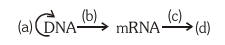
Read the following statements and choose the set of correct statements:
A. Euchromatin is loosely packed chromatin
B. Heterochromatin is transcriptionally active
C. Histone octomer is wrapped by negatively charged DNA in nucleosome
D. Histones are rich in lysine and arginine
E. A typical nucleosome contains 400 bp of DNA helix
Choose the correct answer from the options given below:
If a geneticist uses the blind approach for sequencing the whole genome of an organism, followed by assignment of function to different segments, the methodology adopted by him is called as:
The anatomy of springwood shows some peculiar features. Identify the correct set of statements about springwood.
A. It is also called as the earlywood
B. In spring season cambium produces xylem elements with narrow vessels
C. It is lighter in colour
D. The springwood along with autumnwood shows alternate concentric rings forming annual rings
E. It has lower density
Choose the correct answer from the options given below :
AI-generated explanation. Check against your textbook.
Explanation:
Springwood (earlywood) is formed in the spring and consists of wider xylem vessels and thinner walls, making it lighter in color and with lower density. It forms part of the annual ring with Autumnwood (latewood). Thus A is true, C true, D true, and E true. Statement B is false because springwood has wide, not narrow, vessels. The correct set is A, C, D and E.
🧠 Did You Know?
Annual rings are formed by the alternating growth in spring (earlywood) and late summer/fall (latewood), creating distinct light and dark zones in the stem.
💡 NCERT Memory Line:
Earlywood is lighter, has wide vessels and lower density; latewood is darker and denser, forming the characteristic yearly rings.
In an E.coli strain i gene gets mutated and its
product can not bind the inducer molecule. If
growth medium is provided with lactose, what will
be the outcome?
AI-generated explanation. Check against your textbook.
Explanation:
The lac operon is normally induced by allolactose binding to the lac repressor (product of lacI). When the inducer binds, the repressor releases the operator, allowing transcription of lacZ, lacY, and lacA. If lacI is mutated so the repressor cannot bind the inducer, the repressor remains active and binds the operator even in the presence of lactose, blocking RNA polymerase. Therefore, z, y, a genes will not be transcribed or translated.
🧠 Did You Know?
In NCERT terms, the lac operon is an example of negative gene regulation where the repressor inhibits transcription unless inactivated by an inducer.
💡 NCERT Memory Line:
In the lac operon, transcription occurs only when inactivator (repressor) is inactivated by inducer; a nonfunctional inducer-binding repressor keeps the operon switched off.
If the length of a DNA molecule is 1.1 metres, what
will be the approximate number of base pairs?
AI-generated explanation. Check against your textbook.
Explanation:
In DNA, each base pair spans about 0.34 nanometres (3.4 × 10^−10 m). For a DNA length of 1.1 m, the number of base pairs ≈ 1.1 / (3.4 × 10^−10) ≈ 3.2 × 10^9 bp, i.e., about 3.3 × 10^9 bp. Therefore, the correct choice is 3.3 × 10^9 bp (option 2).
🧠 Did You Know?
One human diploid cell contains about 6.6 × 10^9 bp in total DNA, arranged into 23 pairs per chromosome set, reflecting the long-tedious length of DNA packaged in the nucleus.
💡 NCERT Memory Line:
DNA length is about 0.34 nm per base pair, so bp count ≈ length / 0.34 nm.
Ten E.coli cells with 15N- dsDNA are incubated in medium containing 14N nucleotide. After 60 minutes, how many E.coli cells will have DNA totally
free from 15N ?
AI-generated explanation. Check against your textbook.
Explanation:
Start with 10 E.coli cells containing 15N- dsDNA. In 14N medium, DNA replication produces one old strand and one new strand per chromosome. After each generation, the proportion of 14N-only DNA increases. After 1st generation (≈20 min): all cells are hybrid (15N-14N). After 2nd generation: 1 cell becomes 14N-14N (light) and 1 remains hybrid per two cells, so 50% light. After 3rd generation: light cells produce two light, and hybrid cells produce one light and one hybrid, giving 3 light and 1 hybrid among 4 cells. With 10 initial cells, total cells after 3 generations = 80; light (14N-only) cells = 3/4 of 80 = 60. So 60 cells are totally free from 15N.
🧠 Did You Know?
This follows the Meselson–Stahl experiment logic used in NCERT to show semi-conservative DNA replication and the appearance of light (14N) and hybrid (15N-14N) DNA generations in a 14N medium.
💡 NCERT Memory Line:
In 14N medium, after n generations, the fraction of 14N-only DNA is (1/2)^(n-1) for the first half? Actually, cumulative: after 3 generations, 3/4 of cells are 14N-only.
The recombination frequency between the genes a &
c is 5%, b & c is 15%, b & d is 9%, a & b is 20%, c & d is 24% and a & d is 29%.
What will be the sequence of these genes on a linear chromosome ?
AI-generated explanation. Check against your textbook.
Explanation:
In a linear chromosome, the recombination frequencies reflect the distance between adjacent genes. The order a–c–b–d gives: a–c = 5%, c–b = 15%, b–d = 9%. Then a–d = 5 + 15 + 9 = 29%, c–d = 15 + 9 = 24%, and a–b = 5 + 15 = 20%, all matching the given data. Hence the correct gene sequence is a, c, b, d. Options that place the genes in different adjacent arrangements do not fit all the given recombination frequencies. For example, option 2 (a, b, c, d) would not produce a–c = 5% and c–d = 24% simultaneously, etc.
🧠 Did You Know?
Recombination frequency is used to map genes on a chromosome in map units (mu); 1% recombination equals 1 mu, a key NCERT concept in genetic mapping.
💡 NCERT Memory Line:
Order the genes so that all pairwise distances add up to the given figures; the adjacent distances must sum to the total distances for non-adjacent pairs.