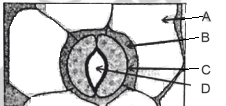
In the given figure, which component has thin outer walls and highly thickened inner walls?
AI-generated explanation. Check against your textbook.
Explanation:
Component C corresponds to the endodermis in plant roots. Endodermis has relatively thin outer walls but its inner radial and tangential walls are thickened by suberin and lignin, forming the Casparian strip that regulates water and mineral uptake. This matches “thin outer walls and highly thickened inner walls.”
? Did You Know?
NCERT describes endodermis as the innermost layer of cortex with a prominent Casparian strip in radial walls, ensuring selective transport into the vascular system.
? NCERT Memory Line:
Endodermis: thin outer walls; thickened inner walls due to Casparian strip that controls substances entering xylem.
What is the fate of a piece of DNA carrying only gene of interest which is transferred into an alien organism?
A. The piece of DNA would be able to multiply itself independently in the progeny cells of the organism.
B. It may get integrated into the genome of the recipient.
C. It may multiply and be inherited along with the host DNA.
D. The alien piece of DNA is not an integral part of chromosome.
E. It shows ability to replicate.
Choose the correct answer from the options given below:
Explanation: NCERT Page No.194, (Topic-11.1 PRINCIPLES OF BIOTECHNOLOGY)
Which one of the following can be explained on the basis of Mendel's Law of Dominance?
A. Out of one pair of factors one is dominant and the other is recessive.
B. Alleles do not show any expression and both the characters appear as such in F2 generation.
C. Factors occur in pairs in normal diploid plants.
D. The discrete unit controlling a particular character is called factor.
E. The expression of only one of the parental characters is found in a monohybrid cross.
Choose the correct answer from the options given below:
Explanation: NCERT Page No.59,(Topic-4.2.1 Law of Dominance)
Statement I: Bt toxins are insect group specific and coded by a gene cry IAc.
Statement II: Bt toxin exists as inactive protoxin in B. thuringiensis. However, after ingestion by the insect the inactive protoxin gets converted into active form due to acidic pH of the insect gut.
In the light of the above statements, choose the correct answer from the options given below:
Explanation: NCERT Page No.208,(Topic-12.1 BIOTECHNOLOGICAL APPLICATIONS IN AGRICULTURE)